
Insights

Career Intelligence Brief · Issue 1 · 1 September 2026

The NFL, Brisbane 2032 and why capability travels further than industry

What we're seeing, reading and thinking about in careers, jobs and the changing world of work. An Australian market snapshot, one trend that matters, useful data and something worth your time.

The market

What we're seeing in Australian employment

  • Unemployment rate

    4.5%

    Up from 4.2% a year earlier

    The labour market has softened, but unemployment remains relatively low.

  • People employed

    14.81m

    1.3% higher than a year earlier

    Despite a slight fall in July, employment is above where it sat a year ago.

  • Online job ads

    212,200

    Up 2.7% in July

    Job ads remain around 25% above the 2019 average.

  • Wage growth (annual)

    3.2%

    Down from 3.4% a year earlier

    Wage growth has moderated, easing cost pressures.

  • Job mobility rate

    7.2%

    Down from 9.6% in 2023

    Australians are changing employers less often.

Reference periods: employment, unemployment and online job advertisements, July 2026; annual wage growth, June quarter 2026; job mobility, year to February 2026. Sources: ABS Labour Force, ABS Wage Price Index, ABS Job Mobility, Jobs and Skills Australia IVI.

Careerbase take: employers are still hiring, but lower job mobility and higher unemployment point to a more cautious environment for people considering a move. At the same time, significant demand remains for particular skills and occupations.
The trend

The NFL and Brisbane 2032 are a reminder to look beyond industry boundaries

Members of the Careerbase team attended the first NFL regular-season game in Melbourne. The spectacle was memorable, but it also prompted a workforce question: how new industries, investment and consumer demand create career opportunities and retention risks inside companies.

Major sporting events draw on a much wider network than the teams on the field. Venue operations, broadcasting, sponsorship, hospitality, technology and professional services all contribute. Brisbane 2032 extends that lens to the planning, infrastructure and delivery capabilities needed around a major event.

These activities draw on skills already present in other industries: project management, procurement, marketing, engineering, law, data analysis and commercial leadership. Your competition for talent may include organisations you have never treated as peers.

Careerbase take: for employers, that means thinking less narrowly about industry experience and more about transferable capability. For individuals, it means asking a different career question. Not just “What job have I done before?” but “Where else could my skills create value?”

The chart

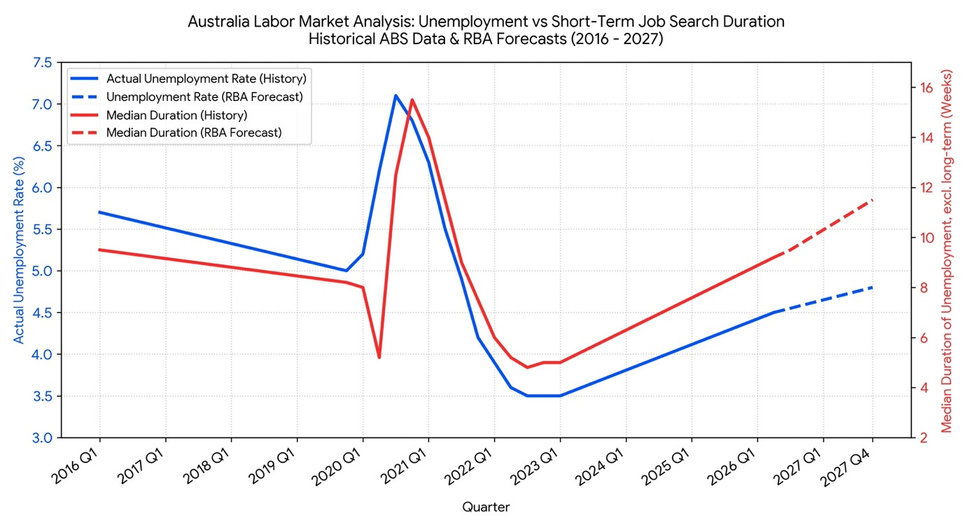
Unemployment and the duration of job search

Line chart comparing the Australian unemployment rate with the median duration of job search from 2016 to 2027, with RBA forecasts shown as dashed lines

Unemployment has drifted from 3.5% in 2023 to 4.5% in early 2026, and the median duration of job search, excluding long-term unemployment, has moved with it: from roughly three and a half weeks to about six. RBA forecasts have both edging higher again through 2027.

Source: Reserve Bank of Australia forecasts and historical ABS data. The duration series excludes long-term unemployment; forecast figures are not observed outcomes.

Careerbase take: a softer market makes realistic expectations and sustained career transition support more important. AI tools can assist with research and applications alongside practical guidance and human support.

Worth knowing

WorkLife with Molly Graham, from TED

This month's pick: “Why success is never linear” with Claire Hughes Johnson. The former Stripe COO joins Molly Graham to discuss the uncertainty, setbacks and persistence behind a successful career, including leading through difficult moments, supporting teams under pressure and deciding when to keep going or change direction.

Signals

  • AI isn't gutting the Australian labour market, yet

    A Department of Employment and Workplace Relations report finds no evidence of broad AI-driven job losses in Australia. Jobs for 20 to 24 year-olds have grown slightly faster than for older workers. Occupations most exposed to AI, such as clerical and administrative roles, are growing at roughly half the rate of the least-exposed ones, suggesting a gradual reshuffling rather than a sudden shock.

  • Rewarding human capabilities alongside technology adoption

    EY US has announced a US$100 million investment in rewards recognising future-focused skills, innovation and impact, including judgement, adaptability and business acumen. Worth considering when designing your own incentives and rewards.

  • Graduate hiring is slowing, is AI or remote work to blame?

    The US debate about entry-level employment raises questions about AI, remote work and the opportunities available to graduates.

Get the Career Intelligence Brief

A short read on careers, skills and the changing world of work, straight to your inbox.